
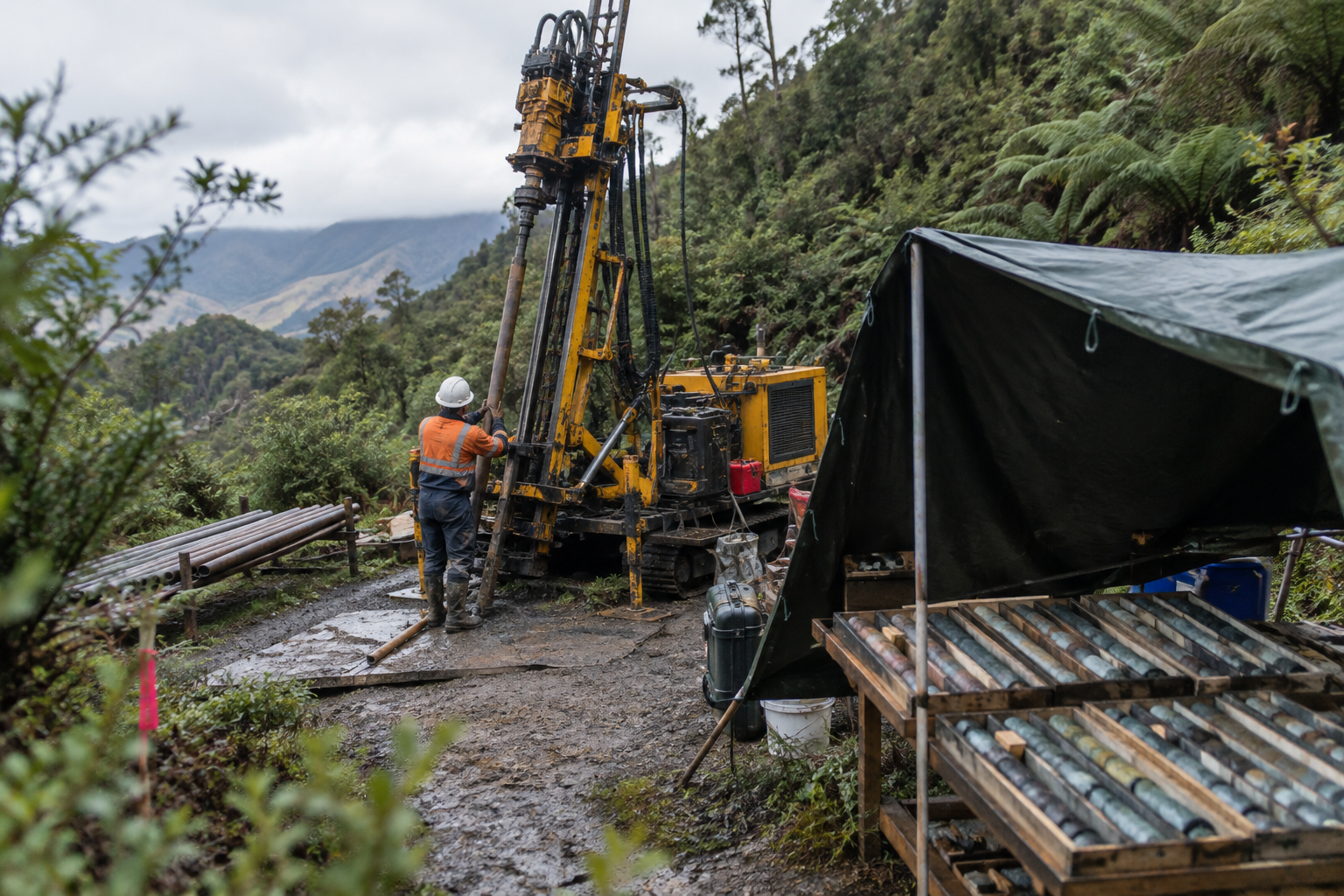
For resource investors, a high-grade drill result is less a victory lap than a flare shot into the night: a signal that a company’s geological story may still have chapters left to write. OceanaGold Corporation’s report of results from 16 new drill holes at Wharekirauponga gives its exploration pipeline a fresh point of focus.
The update also includes reported progress on the Waihi North project, creating a two-part narrative for OceanaGold’s dual-listed shares: ongoing resource conversion at Wharekirauponga and continued development of a broader growth pipeline. The company trades as TSX: OGC and NYSE: OGC.
According to the company update, the 16 holes formed part of an ongoing exploration and resource conversion program at Wharekirauponga. That distinction matters. Exploration seeks to improve understanding of a mineralized system, while resource conversion can help build greater confidence around material already identified. The announcement, as covered by Investing News, places both activities within the same continuing program.
Why high-grade drilling draws attention
High-grade results tend to command attention because grade is one of the central pieces of the mining economics puzzle. It does not, by itself, establish a mine plan, a resource estimate or a production schedule. But it can encourage investors to look more closely at what a company may be able to delineate, convert or advance over time.
That scrutiny arrives against a backdrop of continued interest in precious metals as a potential hedge against inflation and rate uncertainty. In that environment, exploration news can act as a reminder that a mining company’s valuation story is not limited to current operations. It may also include the possibility of extending or adding to its future project base.
Waihi North broadens the conversation
OceanaGold’s reported progress on Waihi North gives investors another project to place beside the Wharekirauponga drilling results. The significance is not that the update automatically changes the company’s operating outlook; rather, it may prompt the market to examine how the two initiatives fit within OceanaGold’s longer-term growth pipeline.
For a company listed on both the Toronto Stock Exchange and the New York Stock Exchange, that pipeline can be watched by a wide pool of North American resource investors. The 16-hole result provides a concrete exploration datapoint, while Waihi North adds a second strand to the company’s project narrative. Together, they could influence the amount of market attention directed toward $OGC, without establishing that the share price has moved in response.
What investors still need to assess
The disciplined reading is the important one. High-grade drilling is encouraging in tone, but the announcement summarized here does not provide assay grades, mineral estimates, project timelines or price data. Those missing pieces matter when investors assess scale, continuity, economics and the path from exploration work to a potential development decision.
For now, OceanaGold has supplied two items for the market’s watch list: results from 16 new Wharekirauponga drill holes tied to exploration and resource conversion, and reported progress at Waihi North. That may be enough to keep OGC’s growth pipeline in the conversation, while the harder questions remain geological, technical and financial.
Bull/Bear Verdict
Bull Case: The 16 new Wharekirauponga drill holes, combined with reported progress at Waihi North, may increase investor attention toward OceanaGold’s exploration and growth pipeline.
Bear Case: The update does not establish assay grades, mineral estimates, project timelines or a share-price reaction, so the ultimate market significance of OGC’s results remains uncertain.