Jerome Powell’s Crucial Test: Can He Steer the Economy Away from Recession?
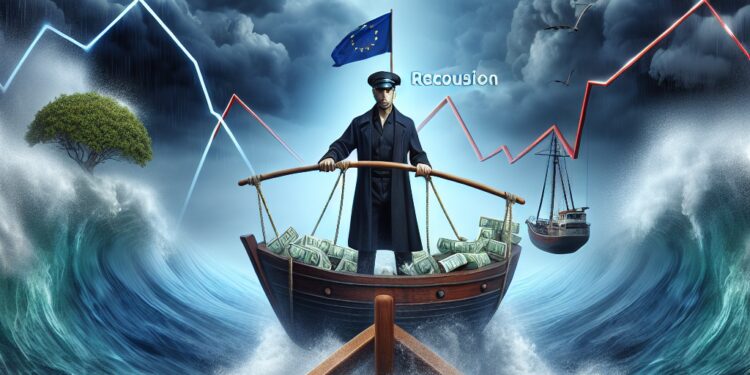
Recession Fears Looming: Will Powell Respond to Market Pressures?
The specter of a recession is haunting America once again, and this time the economic landscape feels precarious under the new Trump administration’s policies. Following a period where financial markets seemed unfazed by weaker economic indicators, investor sentiment has taken a definite turn towards caution. With stock market activity suggesting a downturn, all eyes are on Federal Reserve Chair Jerome Powell this week as he faces a trilogy of issues that could sway the direction of the economy.
The Four Challenges Ahead for Powell and the Fed
In the coming days, Powell will be scrutinized on four critical issues that are currently shaping investor expectations. First and foremost is the issue of economic fragility. Recent forecasts from economists have plummeted alarmingly. Former Boston Fed President Eric Rosengren revised his growth estimation for the year down to just 1%, a significant decrease from his prior forecast of 2.4%. Similarly, Julia Coronado, president of MacroPolicy Perspectives, indicated that consensus among analysts has shifted from 2.2% to just 1.5%. This environment of declining growth projections is generating palpable concern among both consumers and businesses.
Secondly, there is mounting speculation over the potential for interest rate cuts. Traders in derivative markets suggest that three quarter-point cuts may be on the horizon this year. Yet, according to Diane Swonk, chief economist at KPMG, Powell faces a dilemma: should he cut rates to support a slowing economy, or should he exercise caution and hold off until inflation shows clear signs of subsiding?
Adding to the complexity of Powell’s decision-making is the third challenge—an unpredictable tariff policy that has implications for economic growth. Initially, markets anticipated that China would be the central focus of U.S. tariff initiatives; however, chaos has erupted as tariffs spread to key trading partners like Mexico and Canada. Economists warn that this broadening of tariffs could exacerbate inflation, ultimately constraining the Fed’s ability to respond rapidly to economic deterioration.
Inflation vs. Economic Growth: A Tightrope Walk
Finally, the fourth concern is inflation’s stubbornness amidst these uncertainties. With inflation exhibiting surprising strength earlier this year, consumer expectations regarding future inflation have surged. This sticky inflation may compel the Fed to maintain its existing policy stance longer than previously anticipated, as pointed out by Robert Kaplan, the former president of the Dallas Fed. He and many others agree that the Fed may find itself more reactive than proactive in 2025, potentially limiting the ability to cut rates at the first signs of economic weakness.
Markets Await Fed’s Decision
The Fed’s imminent statement and economic forecast, set to be released at 2 p.m. Eastern on Wednesday, will inevitably contain insights on how they perceive the current economic climate. Expectations suggest a continued hold on the benchmark interest rate as the Fed adopts a “wait-and-see” approach. Rosengren posits that we will likely see cuts later this year if economic conditions deteriorate markedly, with recession odds now hovering at 30%, a stark climb from the normal 15%.
The Complexity of Rate Cuts
It’s imperative to understand that rate cuts, while potentially beneficial, are not a silver bullet for the market’s unease. Coronado explicitly stated that a rate cut is unlikely to serve as a panacea for the multitude of concerns facing investors and businesses today. In the face of unstable immigration policies, looming federal budget cuts, and the reconfiguration of global alliances, uncertainty will be a driving force that complicates decision-making across the economy.
Conclusion: Powell’s Crucial Moment
The coming days are set to be pivotal, not just for Jerome Powell but for the entire U.S. economy. As financial markets digest the implications of Trump’s policies, along with fluctuations in inflation and trade relations, the Federal Reserve must navigate through these turbulent waters with a level head. Will Chair Powell rise to the occasion to instill confidence in the markets and the American people? The stakes couldn’t be higher.